Georges Ivanovich Gurdjieff (1886-1949) was a mystic, philosopher, and spiritual teacher who revolutionized Western understanding of self-awareness, consciousness, and human potential.
His ideas, though controversial in his time, continue to provoke curiosity and fascination among spiritual seekers, philosophers, and psychologists today.
But who exactly was Gurdjieff, what did he believe, and why did he attract the attention of powerful institutions? Let’s explore.
Gurdjieff: Ahead of His Time
What Was Gurdjieff Known For?
Gurdjieff was best known for his teachings on human consciousness and self-development.
He developed a system known as “The Work,” which combined elements of Eastern mysticism, Western psychology, and esoteric philosophy.
His goal was to help individuals awaken to their true potential and break free from the mechanical, unconscious patterns that govern everyday life. Through a combination of physical exercises, meditation, and self-reflection, he aimed to show people how to transcend the limitations of their ego and achieve a higher state of being.
What Did He Believe?
At the heart of Gurdjieff’s philosophy was the belief that human beings are not truly awake, that we live in a state of “sleep,” driven by automatic habits and conditioned responses.
He believed that to reach higher states of awareness, individuals must confront the deeper aspects of their own consciousness and break free from their conditioned patterns.
This process was designed to help people cultivate an inner discipline, allowing them to awaken to a more genuine, self-aware existence.
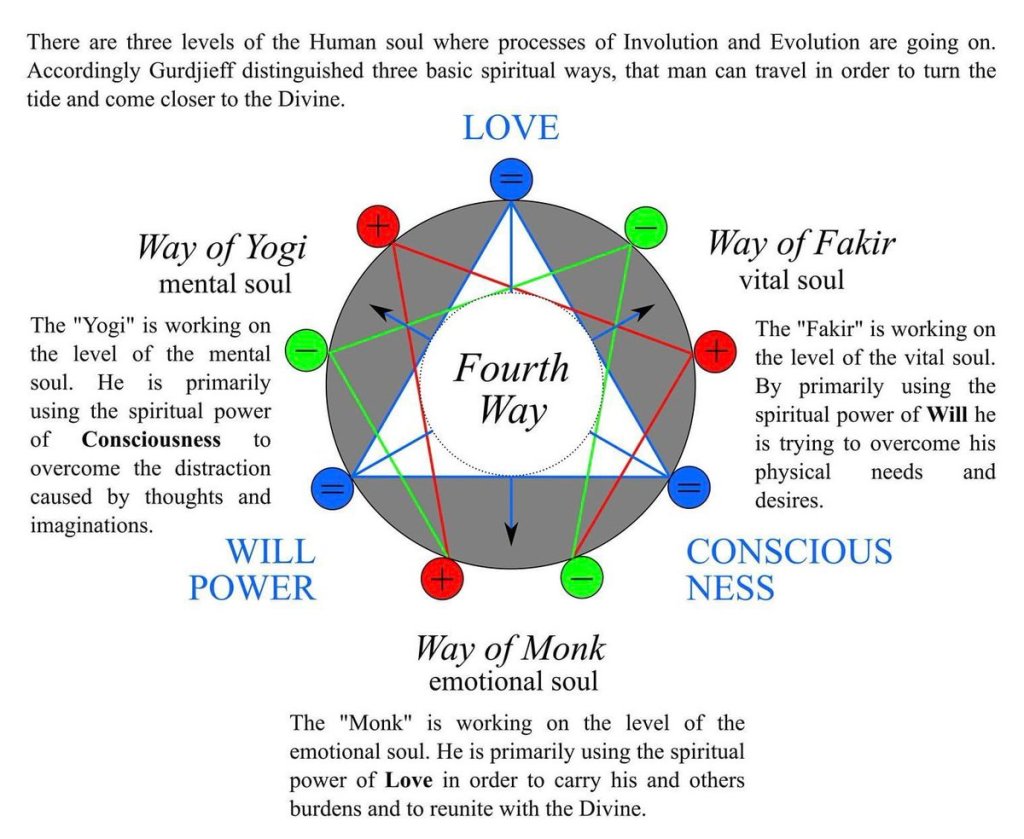
Gurdjieff also believed in the concept of the “Fourth Way,” which according to Gurdjieff, involved integrating all aspects of being: mind, body, and emotion, into a single cohesive experience. This approach allowed practitioners to engage in spiritual development while still living active lives in the world.
What Did Gurdjieff Discover?
Gurdjieff’s discoveries were primarily focused on the nature of human consciousness and how it could be awakened.
He believed that most people lived in a state of “mechanicalness,” reacting to life rather than consciously engaging with it. One of his key teachings was the idea of “self-remembering,” a practice designed to help individuals become more aware of their thoughts, emotions, and actions in the present moment.
He believed these practices could break through the barriers that kept people in a state of unconsciousness, enabling them to live more fully in the present.
Why Were “The Powers That Be” Concerned About Him?
Gurdjieff’s teachings were controversial, and they raised alarms among both religious and political institutions.
His challenge to the status quo, particularly his critique of modern Western society’s mechanical, materialistic worldview, threatened entrenched systems of power that depended on control and conformity.
Gurdjieff’s approach to awakening individuals from their unconscious states could be seen as a threat to the existing social order, which relied on a population that followed established norms without question.
His radical approach to spiritual development and his disregard for conventional structures made him both a figure of fascination and fear.

Final Thoughts
Gurdjieff was a man ahead of his time. His ideas offer a profound challenge to how we view our existence and the nature of consciousness.
His teachings emphasize the importance of self-awareness, discipline, and the integration of mind, body, and emotion in the pursuit of a higher state of being.
On a personal note, I find Gurdjieff’s approach to life quite compelling, especially his call for self-awareness and the breaking of unconscious patterns. In a world that often feels robotic and disconnected, his teachings provide a way for those searching for more meaningful and intentional ways of living.
I recently watched a video about his life that included some of his teachings.
One basic way to snap out of our conditioned patterns is to observe our thoughts as they are happening, or more specifically to observe the automatic patterns when they are occuring. In this way we can “grab a hold of our own life” in a way and live an intentional life we desire, not one that has been programmed through our social conditioning.
What do you think? Please leave a comment, thanks for reading!
Check out the new Happy Hub Etsy Shop.
Please visit and follow Happy Hub’s Instagram page.
Check out the Happy Hub YouTube Channel.
Check out my printable eBook Living Happy: The Complete Guide To True Contentment.

 Happy Hub