Friedrich Nietzsche is one of the most influential philosophers of modern times.
Born in 1844, Nietzsche’s work continues to resonate today with those questioning traditional values, religion, and the nature of existence.
His ideas challenged the foundations of morality, culture, and even truth itself.
Friedrich Nietzsche: The Rebel Philosopher
Early Life and Career
At just 24, Nietzsche became a professor of philology at the University of Basel in Switzerland, making him one of the youngest to ever hold such a position. But his academic career was short-lived due to chronic health problems, including migraines and partial blindness. He resigned at 34 and spent the rest of his life writing, although was notably inactive during his final few years.
Nietzsche never married, and much of his life was marked by solitude, illness, and strained relationships. Despite this, he was prolific in his writings, producing some of philosophy’s most provocative and poetic works.
Key Ideas and Beliefs
Nietzsche’s philosophy is not easily boxed into one system. He was a critic, a poet, and a thinker who often contradicted himself.
Let’s discuss several of the major themes that stood out in his work:
“God is dead”
Nietzsche’s most famous statement was probably when he declared “God is dead”.
He wasn’t literally declaring the death of a deity, but instead noting the decline of traditional Christian belief in Western Europe. He believed that science, secularism, and modern life had eroded faith, but nothing had yet replaced it. Without religion as a moral foundation, he warned of a potential crisis in meaning and values.
The loss of traditional religious beliefs could lead to nihilism, the belief that life is inherently meaningless. Nietzsche sought to provide a path out of this despair.
Will to Power
Nietzsche believed that the fundamental driving force in humans wasn’t survival or pleasure, as others suggested, but a “will to power”: a desire to grow, assert, and overcome. This concept plays a central role in his view of human development and excellence.
The Übermensch (Overman/Superman)
In Thus Spoke Zarathustra, a book of philosophical fiction, Nietzsche introduces the idea of the Übermensch: an ideal individual who creates their own values and lives beyond conventional notions of good and evil. The Übermensch is a goal for humanity, someone who rises above herd mentality and embraces life, struggle, and creativity.
The “Overman” embodies courage, intellect, and the joy of life, becoming a force for self-improvement.
Eternal Recurrence
Nietzsche asks: What if you had to live your life over and over again, forever? This idea, known as eternal recurrence, is a test of how one lives. Would you say yes to reliving every joy and suffering, or would it be unbearable?
For Nietzsche, affirming eternal recurrence is a sign of loving life deeply and fully. He presented this idea as a hypothetical thought experiment that serves as a test for one’s love of life.
Master and Slave Morality
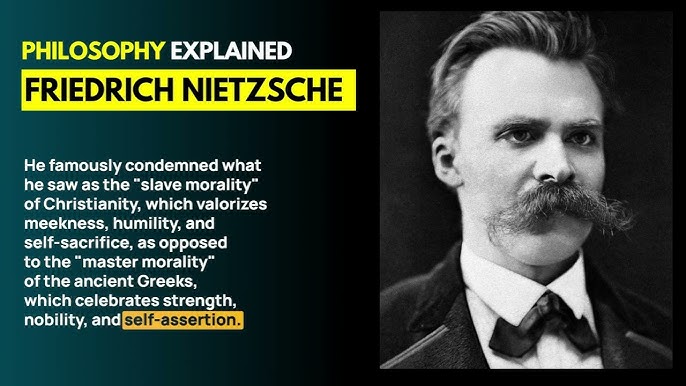
Nietzsche distinguished between “master morality” and “slave morality.”
Master morality arises from strength, nobility, and affirmation of life. Slave morality, by contrast, comes from resentment and weakness as it values humility, pity, and obedience.
He believed that Western morality, heavily shaped by Christianity, was dominated by slave morality, which suppressed human potential.
Mental Decline and Death
In 1889, at the age of 44, Nietzsche suffered a mental breakdown in Turin, reportedly collapsing after witnessing a horse being whipped. He never recovered mentally and spent the last 11 years of his life in the care of his mother and later his sister, Elisabeth.
His mental deterioration unfortunately meant an inability to write publishable material for the remaining years of his life, which he spent in seclusion.
He suffered at least two strokes during his final years, and contracted pneumonia before dying in 1900 at the age of 55.
Legacy and Influence
Nietzsche’s ideas have had a profound impact across philosophy, psychology, literature, art, and even political theory.
He influenced almost every existentialist thinker, psychoanalyst, and writer that came after him in the 20th century.
Today, Nietzsche is celebrated for his deep insights into human psychology, morality, and the struggle for meaning. His writing style is known to be unique and compelling.

Final Thoughts
This post was based on my own research that included watching videos, reading articles, and asking Google some basic questions about this fascinating individual. The trail gets long when you start following his ideas and influence.
I found the last few years of his life hard to read about, and imagine he may have had many other ideas that we’ll never know about. I hope some of those concepts brought him some level of comfort.
Rather than avoiding suffering, Nietzsche encouraged embracing it as a catalyst for growth and self-discovery. He believed that by diving into pain and learning from it, one could emerge stronger and more resilient.
He dared to question everything: God, morality, truth, and the human condition.
He didn’t offer easy answers, but instead challenged us to face life courageously, create our own values, and live authentically.
Thanks for reading.
Check out the Happy Hub Etsy Shop.
Please visit and follow Happy Hub’s Instagram page.
Check out the Happy Hub YouTube Channel.
 Happy Hub